
Gone are the days when products were launched without prior testing. Modern manufacturing does not launch any product without specific tests. Among these, the thermal shock and thermal cycling tests are two of the most popular. However, people often debate thermal shock vs thermal cycling testing.
Interestingly, many believe both tests are the same because they both involve heating a material or product. However, this is wrong, as the two tests are different and provide unique information about the products. They are used on products that face both high and low temperatures, but in totally different ways. In this article, I will discuss the differences between thermal shock and thermal cycling testing.
What is Thermal Shock Testing?

The use of thermal shock tests is common in a wide range of industries. All parts intended for use in fluctuating temperatures undergo this testing.
Thermal shock tests involve exposing material (sample) to two extreme temperatures. The sample is exposed to very high temperatures. After that, it is exposed to very low temperatures (up to -40°C). This sudden change of temperature from very high to low can cause internal stress in the sample. If the material is strong, it won’t crack or break, proving its durability and reliability.
As you know, some parts experience both very high and very low temperatures. Showing good performance in these extreme temperatures is crucial. If the material is not pre-tested, it might fail when exposed to such extreme temperatures. That’s where thermal shock testing proves to be highly useful.
This thermal shock test is conducted in a thermal shock chamber. There are different types of thermal shock chambers available. However, two-zone thermal chambers are most commonly used in testing. The part or material to be tested is placed in the bucket. This bucket takes the material to a zone where the temperature is too high (up to 150°C).
After some time, the bucket moves, transferring the material to another zone where the temperature is very low. This temperature can be negative, around -40 degrees Celsius. This sudden change in temperature from extremely high to extremely low affects the material. It undergoes both expansion at high temperatures and contraction at low temperatures.
If the material is strong, it can withstand both expansion and contraction without cracking or damage. The material is exposed to these extreme temperatures many times. Materials that pass the thermal shock test are considered reliable and strong. They can withstand sudden temperature changes and are ready for use in real-world conditions.
What is Thermal Cycling Testing?
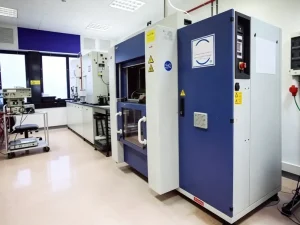
Thermal cycling and thermal shock tests differ from each other. Thermal shock exposes material to extreme temperature changes. However, thermal cycling tests are all about exposing material to stress and fatigue.
Thermal cycling tests involve exposing material to both very high and low temperatures. However, it does not increase the temperature suddenly, as happens in thermal shock tests. Instead, it gradually increases the temperature and then gradually decreases it. This happens hundreds of cycles. A weak material starts to crack due to continuously fluctuating temperatures.
Simply put, this test involves repeatedly heating and cooling the materials. This test also exposes the material to extremely high temperatures (120–125°C) and extremely low temperatures (-40°C). However, it does not fluctuate this temperature suddenly. Instead, the temperature rises and falls slowly, exposing the material to fatigue and stress.
In this testing, an environmental test chamber or thermal cycling chamber is used. The product or material to be tested is placed in this chamber. After that, the operator gradually increases the temperature. This increase in temperature causes the materials to expand. After a set period, the operator slowly reduces the temperature and then brings it up to -40°C.
This testing involves hundreds of thousands of cycles of temperature increases and decreases. These small increases and decreases do not expose the material to thermal shock. Instead, they cause stress and fatigue in the material. If the material is reliable, it resists fatigue and shows no wear or tear even after hundreds of cycles.
Once the test is complete, the engineer carefully analyzes the material’s condition. Any sign of cracks indicates that the material requires improvement. This testing is widely used in automotive, aerospace, electronics, and many other industries. Parts that pass this test are used to make various products that prove very reliable.
Differences Between Thermal Shock and Thermal Cycling Test
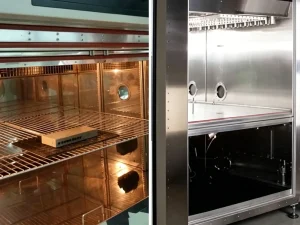
As discussed above, thermal shock and thermal cycling tests differ. As both involve high and low temperatures, this does not mean they are the same. In the section below, you’ll learn about their key distinctions.
1- Temperature Change Rate
The rate of temperature change is an important aspect of these two tests. In thermal shock testing, the temperature changes very quickly. First, the product is exposed to very high temperatures (extreme). Suddenly, the temperature drops within seconds, exposing the product to a very low temperature. This temperature fluctuation occurs within seconds.
On the other hand, thermal cycling tests involve gradual temperature changes. The product is gradually exposed to high temperatures, reaching the maximum limit. After some time, the temperature is reduced slowly. This slow and gradual change in temperature exposes products to fatigue and stress.
2- Testing Purpose & Thermal Exposure
Thermal shock testing is conducted to know how a material behaves when exposed to sudden, extreme temperature changes. In this method, the product is exposed to extreme temperatures (both low and high). If a product is weak and subjected to extreme temperatures, its weakness becomes evident.
On the other hand, a thermal cycling test is conducted to assess the extent of repeated stress the material is subjected to. When the temperature changes gradually, it exposes the material to stress. This is done in hundreds of cycles, exposing the material to repeated stress. If the material cracks, it is not reliable under repeated stress and requires improvement.
3- Stress Intensity & Stress Duration
Thermal shock and thermal cycling tests differ in terms of stress intensity and duration. In thermal shocks, temperature changes very quickly. First, it rises to a very high temperature, then drops to an extremely low temperature. This way, it exposes the material to high stress intensity. However, the stress duration is short because the temperature changes quickly.
On the other hand, stress intensity in thermal cycling tests is low. The reason is that temperature change happens slowly and gradually. In contrast, stress duration is long in the thermal cycling test.
4- Transfer Method & Real-Life Simulation
Thermal shock tests involve suddenly transferring the material from an extremely high to a low temperature. As I said above, the test is conducted in a thermal shock chamber consisting of two chambers. The material is placed on a bucket that puts it in a hot chamber, so the material faces an extremely high temperature. After that, the bucket immediately moves and takes the material to a low-temperature chamber.
This transfer of material from high to low temperature happens within seconds. This simulates the condition in which material goes from an extremely high value to a very low value quickly. A thermal cycling test is conducted in a single chamber where the temperature increases and decreases. Material does not have to be transferred from one chamber to another. This mimics the condition in which material experiences extreme temperatures fluctuating slowly.
5- Testing Speed & Number of Cycles
A thermal shock test is better for testing speed. Why? The reason is that this test involves a sudden change of temperature from extremely high to low. If the product is weak, it starts to show signs of cracking in the first few cycles. So this thermal shock test completes quickly. Additionally, this test involves fewer cycles.
On the other hand, a thermal cycling test takes longer because it involves a gradual temperature change. The temperature increases slowly at first, then decreases more slowly. Additionally, the thermal cycling test involves more cycles, i.e., hundreds. You cannot predict the outcome just by a few cycles in this testing method.
6- Equipment Type Used & Chamber Design
Thermal shock testing is carried out in dedicated thermal shock chambers. These chambers are available in different types. These include dual-zone thermal shock chambers, three-zone thermal shock chambers, and so on. These chambers have dedicated sections or compartments for both heating and cooling.
They consist of a bucket that holds material and then moves from the hot to the cool compartment. On the flip side, thermal cycling tests are typically conducted in a single-zone environmental chamber. Both increases and decreases in temperature happen in this single environmental chamber. In terms of design, a thermal shock chamber consists of two or three compartments.
Frequently Asked Questions
What is a thermal shock chamber?
The thermal shock chamber is a testing machine. It consists of two zones dedicated to heating and cooling the product under test. These machines can achieve extreme temperatures with ease.
Which test is more severe: thermal shock or thermal cycling?
The thermal shock test is typically more severe than thermal cycling. The reason is that this test involves suddenly exposing the workpiece to very high temperatures. This sudden change of temperature makes the thermal shock test more severe.
What is the difference between the thermal shock test and thermal cycling?
Both of these thermal tests are different in many ways. Thermal shock involves examining material behavior under sudden, extreme temperature changes. Thermal cycling tests assess how it behaves when repeatedly exposed to changing temperatures.
Conclusion
In conclusion, both thermal shock and thermal cycling tests are equally important. Both of these tests involve checking a material’s behavior against fluctuating temperatures. Thermal shock tests check a material’s behavior when it faces sudden extreme temperatures.
On the other hand, thermal cycling tests check materials by repeatedly changing temperature. Both do the same thing – they check the quality of the material. Those materials that pass these tests are considered more reliable for use in real-world conditions. You’ll see both of these tests being used in aerospace, electronics, automotive, and other sectors.