
As you know, HVAC/R equipment works in some pretty tough conditions. There, moisture, condensation, salt, and heat slowly attack their metal surfaces. This eventually causes corrosion. But once corrosion starts, it reduces equipment life, affects performance, and leads to costly repairs. To reduce these negative outcomes, protective coatings are used. They create a barrier between the metal and its surroundings. However, have you ever wondered how manufacturers know if a coating will actually protect the metal? That’s where corrosion testing comes into the scene. But if you are new to this topic, worry not! In this guide, I will discuss different corrosion tests for HVAC/R protective coatings. You will know how these tests work and how they are performed. So let’s get started.
What Is Corrosion Testing for HVAC/R Protective Coatings?

Corrosion testing is a way to check how well a protective coating protects HVAC/R metal parts from corrosion. In this test, a coated metal sample is placed in controlled conditions that can cause corrosion. The test shows how the coating reacts to moisture, salt, chemicals, or other harsh conditions.
In simple words, corrosion testing tells us how strong and reliable the coating is. As you know, HVAC/R equipment is subject to many conditions during normal use. Moisture can collect on coils, outdoor units can face rain and humidity, and more. All this slowly damages unprotected metal. In these situations, a protective coating works like a barrier.
However, that barrier can also weaken over time. Corrosion testing helps find out whether this coating will keep doing its job under these conditions. But one thing you must keep in mind is that not every corrosion test checks the same thing. Some tests focus on salt and moisture. However, some tests check humidity, chemicals, sunlight, or temperature changes. After all testing, the coating is checked for problems such as rust, blistering, cracking, peeling, or loss of adhesion.
Common Corrosion Tests for HVAC/R Protective Coatings
Now you have a basic understanding of corrosion testing. Right? Now remember that not all corrosion tests work in the same way. Each one exposes the coating to different conditions and helps reveal a different type of weakness. So let’s dive in and discuss some common corrosion tests performed on HVAC/R protective coatings.
1- Salt Spray Test
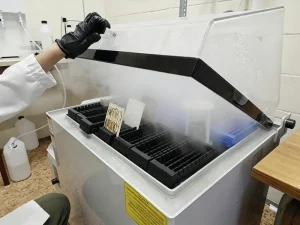
The first most common test for checking the reliability of protective coating is the salt spray test. In this test, a metal panel covered with protective coating is used. This panel is placed inside a special salt spray chamber. The chamber sprays a fine salt solution into the air. This creates a wet and salty environment around the sample. The sample stays inside for a set amount of time. The salty moisture attacks the exposed surface and puts the coating under harsh conditions.
After the test, the sample is carefully checked for signs of damage. Technicians look for rust, bubbles, cracks, peeling, or corrosion spreading under the coating. But why use salt? Actually, salt, especially chloride salts, accelerates corrosion. This makes the test useful for coatings used in environments where salt is present. This is done for HVAC/R equipment that will be used near the coast.
2- Cyclic Corrosion Test
The second test is a cyclic corrosion test that checks how the coating will behave under moisture and changing weather. Unlike a salt spray test, it does not keep the coated sample under a single condition at all times. Instead, the sample goes through different stages, such as salt, moisture, drying, and temperature changes. First, a coated metal sample is placed inside a specialized testing chamber. The sample is first exposed to a salt solution or salty mist.
After that, the conditions change to high humidity, condensation, or a drying stage. In the end, the temperature changes from hot to cold and vice versa. These repeated changes put stress on the protective coating. A coating that looks strong under one condition might crack, peel, or lose its protective properties under another. So all these conditions together test the strength of the coatings.
3- Humidity Test
You will agree with me that moisture is one of the biggest enemies of metal. That’s why a humidity test is used to see how well an HVAC/R coating will protect a metal surface in a damp environment. This moisture is one of the most important parts of the normal operation of HVAC systems. So this test verifies that the protective coating will continue working.
During the test, the coated metal sample is kept inside a controlled chamber. Here, the humidity and temperature are carefully maintained. The sample remains there for a specified period. This gives moisture plenty of time to interact with the coating. Once testing time is over, the surface is examined closely. If there are blisters, rust, peeling, or cracks, they are clear signs that this protective coating will not perform well.
4- Water Immersion Test
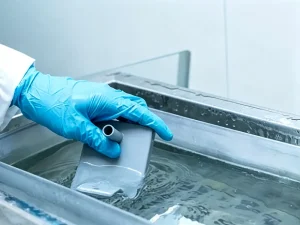
As the name suggests, this test shows how direct water exposure affects the protective coating on HVAC/R parts. Basically, the HVAC/R part gets wet regularly. Water collects because of condensation, leaks, cleaning, or outdoor exposure. Now, if the coating has small weak spots, water slowly enters them. Over time, this causes the coating to lose its strength. To ensure this, a water immersion test comes in.
In a humidity test, you see the sample is surrounded by moist air. But this test puts the coated metal directly into water. For the test, a coated metal sample is placed in water under controlled conditions. The sample is then left in the water for a set period. This prolonged contact gives the coating a chance to show how it handles continuous moisture exposure. After exposure, the sample is removed and examined. The main things to look for are blisters, swelling, peeling, rust, softening, and cracking.
5- Prohesion Test
The Prohesion test is an accelerated corrosion test. It is performed to see how well a protective coating will handle harsh wet and dry conditions. Outdoor units do not stay wet all the time. A condenser or other exposed component gets wet from rain or salty moisture. After some time, they dry when the weather actually changes.
These changes highly affect many coatings in HVAC/R components. To see the effect of these changes, a Prohesion test is used. In this test, the coating is exposed to a fine salt solution. After some time, it is then allowed to dry. This happens for many cycles. These wet and dry periods are repeated to put the coating under stress. After the required exposure, the coating is examined for signs of failure.
6- Chemical Resistance Test
A protective coating has to deal with more than just water and salt. In some HVAC/R environments, it also comes into contact with cleaning products, oils, and chemicals. Chemicals slowly attack a coating even when there is no visible corrosion at first. The coating becomes soft, swollen, discolored, cracked, or weak.
Once the protective layer is damaged, moisture and air will reach the metal more easily. So, a chemical resistance test checks whether these substances damage the coating or reduce its ability to protect the metal. The sample is exposed to a particular chemical for a set amount of time. However, the chemical and exposure time are chosen according to the conditions. Afterward, the sample is checked to see whether the coating has changed.
7- UV and Condensation Test
If an HVAC/R unit is installed outside, its coating must withstand two common problems. The first one is sunlight, and the second is moisture. The UV and condensation test is what checks how well the coating handles these conditions. The UV part of the test represents the sunlight that outdoor equipment receives. The condensation part adds moisture to the test.
To perform the test, a coated metal sample is placed inside a testing chamber. The sample undergoes repeated cycles of UV light and moisture. These changes are repeated to put the coating under conditions that speed up its aging. After the test, the sample is checked for changes. The coating will be examined for fading, chalking, cracking, blisters, and peeling.
8- Temperature Cycling Test
HVAC/R equipment does not always stay at the same temperature. Its parts become hot, cool down, and then heat up again during normal operation. This changing temperature often causes cracks or swelling in the protective coating. So, in a temperature-cycling test, the protective coating is confirmed to handle these conditions.
The testing equipment used for this test is a thermal cycling test chamber. In this chamber, the temperature alternates between hot and cold. First, the sample is placed in a hot temperature for some time. After that, it is moved to a cold temperature. This cycle is repeated several times. It helps engineers see how the coating reacts to repeated heating and cooling.
Why One Corrosion Test Is Not Enough for HVAC/R
One corrosion test cannot tell us everything about a protective coating. The main reason is that HVAC/R equipment does not face a single type of condition. It sometimes deals with moisture, salt, sunlight, heat, cold, and repeated temperature changes. Each of these affects a coating differently.
For example, a coating performs very well in a salt spray test. However, it might struggle under strong UV light. Another coating handles high humidity but starts to crack when the temperature keeps changing. So, passing one test does not always mean that the coating will perform well in every environment. This is why different tests are used to identify different problems.
Conclusion
Corrosion starts small, but it becomes a major problem for HVAC/R equipment over time. To prevent this, manufacturers apply different coatings to HVAC/R parts. These coatings act as barriers, preventing the metal parts from direct corrosion. But these coatings face several harsh conditions, like salt, humidity, and temperature fluctuations. That’s why manufacturers must know how these coatings will perform under these conditions. To confirm this, different corrosion tests are performed. In this guide, I have discussed each of those common tests and their purpose. But remember: a coating may pass one test and fail another. So the right testing plan should match the real working environment.