
Have you ever wondered how manufacturers know whether a specific material (such as fabric) is likely to catch fire? That’s because of the flammability test methods. As you know, different materials catch fire at different rates. Some catch fire and burn quickly for a few seconds. On the other hand, some materials or fabrics don’t burn as quickly.
The flammability test helps us assess the behavior of these materials and determine whether they are safe for humans. Flammability testing is widely used in the textile industry. Remember, these tests are essential for ensuring the safety of the cloth or fabric we use. In this article, I will discuss flammability testing and its key methods.
What Is a Flammability Test?

A flammability test is a scientific experiment or testing procedure conducted under controlled conditions. These tests help determine how easily a material (anything) catches fire or ignites when exposed to a heat source. It also reveals the material’s overall behavior while burning.
Interestingly, the flammability test is not limited to any specific object or industry. Instead, you can use it to test the fire ignition of a wide range of materials. Those can include plastics, wood, foam, and more. Remember, these materials are used in our daily lives. Manufacturers study their flammability behavior and use them accordingly.
It helps them develop safer products for humans. Imagine a fabric type that catches fire or ignites quickly. Additionally, its burning creates more char length or causes it to melt. All these factors can pose serious safety risks to humans who wear this fabric. Right? That’s where the flammability test comes to the rescue.
This test helps manufacturers check the properties (flammability) of fabrics. If fabrics are less safe, they are not used in the textile sector, and vice versa. It is noteworthy that flammability tests not only check how quickly a material catches fire. In fact, it is a more detailed test and offers extensive insight into the flammability of specific materials.
Those insights include:
- How fast does a material catch fire
- How long does the material keep burning when the heat source is removed
- How much distance the material gets affected during burning (char distance)
Remember, the flammability test also indicates how a material burns. All this information is critical and plays a key role in human safety. This testing method also separates the safe materials from unsafe ones. I consider this test crucial for customers, manufacturers, and the overall quality of the product (textile fabrics).
Common Flammability Test Methods
As I said earlier, different flammability tests are used. You can use these test methods depending on which material you are testing. Each of these flammability tests is equally important. In the section below, I will discuss each of those flammability testing methods.
1- Vertical Burn/Flame Test (ASTM D6413)
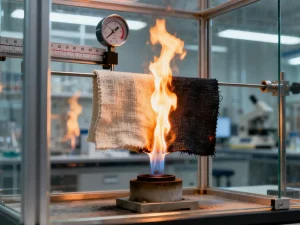
The vertical burn test is one of the most popular methods. You can use this testing method to check the behavior of different fabrics, i.e., curtains, clothing, or upholstery. In this test, a piece of material (fabric) is taken. It is then hung on a clamp in an upright position. In simple words, this sample of fabrics remains hanging.
After that, a heat source is brought to the bottom side, and a flame is applied to the material. The material will catch fire as soon as the flame is applied. The operator then carefully analyzes how quickly the material caught fire and how long it continued to burn. The operator will also analyze the time when further burning of the material was stopped.
Those materials that are slow to catch fire and quickly stop burning are safer. Remember, glow time and char length are crucial factors as well. Glow time is the duration for which the material continues to glow after the flame is removed. Char length indicates the area of the sample that was burnt during this testing process. Each of these parameters is analyzed before the final verdict.
2- Horizontal Burn Test
The horizontal flame test primarily focuses on two types of materials: plastics and fabrics. The overall working of the horizontal burn test is similar to that of the vertical burn test, except for the position of the workpiece. In this horizontal flame test, the sample (specimen) is placed horizontally rather than kept upright.
After that, the operator brings the heat source close and ignites the material. All the other steps and the analysis process are similar in both horizontal and vertical flame testing. Remember, this test is ideal for those parts or products that lie horizontally during their use. Examples of such parts include car dashboards, home carpets, and so on.
3- Flame Impingement Test (ASTM F1358)

This flammability testing method determines whether a specific material is fire-resistant. There are many products in our daily lives for which heat or fire resistance is crucial. For example, firefighter suits must be fire-resistant. Right? All such products are tested with flame impingement testing.
The operator uses the heat source and impinges (directly applies the flame) to the sample of fabric. After that, the analysis is done to determine whether the material caught fire. If it caught fire, the material stopped burning when the heat source was removed. If the material catches fire quickly, it is considered unsafe. Remember, this testing is rigorous because it evaluates the product’s heat resistance.
4- Convective Heat Resistance Test Method (ISO 17493)
This flammability test does not check if the material catches fire when it is brought to flame. Instead, it exposes the sample to hot air instead of flame. During this exposure, the operator notices if the material (fabrics) burns due to consistent exposure to hot air. Remember, this testing is done in either a hot-air furnace or a flammability chamber.
The primary purpose is to check how much material shrinks due to hot air. Materials that shrink more and lose integrity are considered low quality and unsafe. This testing method helps manufacturers get materials that are resistant to hot air. Fabrics that pass this test can be used to make uniforms for employees working in high-temperature environments.
5- 45-Degree Angle Test
This flammability test is based on the sample’s position during the test. In this test, the sample is hung but not vertically or horizontally. It is tilted at 45 degrees and remains hung diagonally. This position allows the fabric to move slightly, which can affect how it burns.
Remember, some fabrics remain hung at different angles during real-world use. This testing addresses the flammability behavior of such materials or fabrics. The operator then provides a flame source to the diagonally positioned material or fabrics. After the test, the sample is analyzed to determine how quickly it ignites and how long it burns.
6- Limiting Oxygen Index (LOI) Test (ASTM D2863)
This test measures the minimum oxygen concentration required for a material to catch fire. As you know, oxygen helps combustion. Right? However, different materials have different LOI, which define their ease of burning. You can test all types of material using this testing method. In this method, the material is kept in a chamber with low oxygen.
The operator then checks if the material catches fire at that specific oxygen level. If it does not, then oxygen concentration is increased further. This testing method helps manufacturers know the minimum oxygen required by a material to burn. In our atmosphere, the oxygen concentration is around 21%. Right? Those materials with an LOI of less than 21% will burn quickly in open air, and vice versa.
7- Radiant Panel Test & Glow Wire Test
The radiant panel test uses a heating element to test the sample. In this test, the heating element (panel) are placed near the material in a controlled environment. This panel provides heat to the material and monitors whether it catches fire from sustained heat exposure. Remember, the material doesn’t directly come into contact with the panel.
Instead, a distance remains between the heating panel and the material under test. This test is more commonly used to assess the coverage of different products. On the other hand, glow wire tests are used in the electronics industry. It checks whether the material ignites upon contact with a hot wire. If the material catches fire when it comes into contact with a hot wire, it is considered less safe, and vice versa.
Conclusion
After the flammability test, each material is classified. Have you ever noticed products labeled with “flame-resistant” or “fire-retardant”? These products are tested using the flammability test method and receive these ratings. Remember, all the tests I mentioned above are used in controlled environments.
Their purpose is to give insight into the flammability of different materials. As a result, manufacturers use the right materials to make products that are safe to use. Without flammability testing, manufacturers won’t know the properties of their materials. As a result, there would be uncertainty about whether the material (fabrics) is safe to use in high-temperature conditions.