
Many products work well under normal conditions. But when they are exposed to high humidity or temperature fluctuations, they start losing their performance. So, have you ever wondered how manufacturers make sure their products perform well in all conditions? The answer lies in the environmental chamber. These are specialized testing machines that create a controlled environment for testing. If you are new to it, this term might feel technical. But there is no need to worry! In this guide, I will discuss how environmental chambers work, their types, and their main parts. So let’s get started.
What Is an Environmental Chamber?

Before we discuss how it works, let’s first understand what an environmental chamber is.
An environmental chamber is a testing machine that tests products under controlled conditions. It creates varying temperature levels and, in many cases, humidity as well inside a fully closed space. These simulations help engineers check how their product behaves in hot, cold, or humid conditions.
An environmental chamber is just like a small room where you can control the weather. The major difference is that you don’t have to wait for long hours or a very hot or cold day. Instead, engineers create those conditions inside the chamber whenever they need them, in no time. For example, if they want to test how a product will work in the cold, they can quickly create very low temperatures inside the chamber.
Similarly, it can create high-temperature and low- and high-humidity conditions inside. So, this testing chamber makes it easier to test a product reliably. As you know, natural weather keeps changing. So repeating the same test outdoors is difficult. That’s where an environmental chamber offers engineers much better control over the conditions. They can choose the temperature, humidity, and test time, then observe how the product responds.
Major Components of an Environmental Chamber
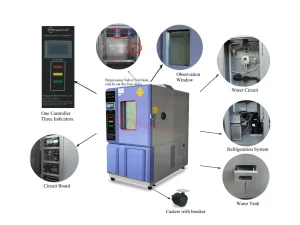
An environmental chamber seems like an enclosed box from the outside. But in reality, it is made of several components that work together to create real testing conditions. To understand how it works, let’s first understand its components and their function.
- Main Insulated Chamber: This is the main area where you place the product or material for testing. Its walls are made of insulating materials. These insulating materials slow down the movement of heat between the inside and outside. As a result, internal conditions remain constant.
- Heating System (Heaters): The heating system is the part that raises the temperature. It normally uses electrical heaters that produce heat when electricity passes through them. If the temperature inside the chamber is lower than the selected range, the controller quickly turns the heaters on.
- Refrigeration System: When the chamber needs to cool down, the refrigeration system takes over. It basically removes heat from the air inside the chamber instead of adding cold air.
- Humidity Generation System: Some environmental chambers also have to control moisture. For this purpose, they have a humidity generation system that adds moisture to the air. A water supply or steam-based system generally increases humidity.
- Fans & Air Circulation: The air circulation inside the chamber is crucial during a test. This is where different fans come into play. They spread heated, cooled, or humidified air around the test space to keep conditions uniform. Without airflow, one area will be warmer or more humid than another, which can affect the final results.
- Sensors: Sensors are the very sensitive parts that tell the chamber what is happening inside. For example, a temperature sensor measures the current temperature. At the same time, a humidity sensor checks moisture levels. These readings go to the controller, which acts quickly.
How Does an Environmental Chamber Work? Complete Process
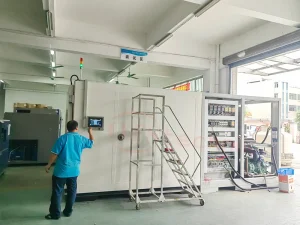
The way an environmental chamber works is very simple. It basically creates the testing conditions that samples can face in real-life use. Not only that, but it also keeps the conditions stable throughout the test. But remember, the process takes place step by step. First, engineers set the required temperature, humidity, and test time for that product. Then they place the product inside the testing chamber. Now the chamber starts working to reach all selected conditions.
For example, if the test needs heat, the chamber adds heat. If it is too cold, the cooling system removes heat. Sometimes humidity is also part of the test. So, the humidity chamber adds or removes moisture from the air. The main point is that the chamber doesn’t run only once. It continuously checks conditions from start to finish. For this, there are sensors inside the chamber. These sensors measure things such as temperature and humidity during the test.
After all this, information goes to the controller. The controller compares the actual reading with the value selected for the test. Suppose the required temperature for the test is 50°C, but the chamber is only at 47°C. In this case, the controller knows there is a need for more heat. That’s why it turns on the heating system until the temperature gets close to the target. During this time, the fans also work to distribute heat evenly, whether it is cold or hot.
When the set test time is complete, the chamber stops the test program. It slowly returns to a normal temperature or humidity without sudden changes. The operator then removes the sample and checks it for any changes or damage. The operator reviews test data, such as temperature and humidity readings, to know how the product performed.
-
How Does Temperature Control Work in the Chamber?
Temperature control is the main job of an environmental chamber. To do this, the chamber uses a temperature monitoring sensor. This sensor mainly checks the air temperature and sends the reading to the controller. The controller compares this reading with the actual temperature the operator set earlier. If the chamber is too cold than the set range, it will turn on the heater. If it becomes too warm, the cooling system starts removing heat.
This cycle continues until you get the results. For example, the test is set at 40°C. The testing chamber first heats the chamber until it reaches 40°C. Once it approaches the target heat range, the heater doesn’t run. Instead, the controller makes small adjustments. It prevents the temperature from rising too far. If the temperature drops, the heating starts again. It means temperature control is a continuous process, not a one-time action.
-
How Does Humidity Control Work In the Chamber?
Environmental chambers also test the effects of humidity on different products. So humidity control is used when a test needs a specific amount of moisture in the air. The engineer sets the required relative humidity, such as 60% RH. But humidity alone is not enough; it also needs a temperature setting. Why? The reason is that slight variations in temperature change the humidity level. The testing chamber must reach both values simultaneously. If there is not enough moisture, the chamber adds water vapor to increase it.
A humidifier, water pan, or steam system inside the chamber provides this moisture. A humidity sensor checks the moisture level and sends the reading to the controller. Once humidity reaches the selected level, the system stops adding moisture. But what if the humidity goes too high? In that case, the humidity testing chamber turns air into liquid. This process is called condensation. The collected water is then removed. Some advanced chambers also contain a dehumidification system. This system helps lower humidity levels.
Most Common Types of Environmental Chambers
Not every product needs the same kind of environmental test. Right? This means a single environmental chamber can’t test every condition. That’s why manufacturers make this testing chamber in many types. Some control temperature, while others control temperature and humidity together. Some testing chambers also perform more specific tests.
Those include rapid temperature changes, sunlight exposure, corrosion, dust, rain, or high-altitude conditions. Let’s discuss the main types of environmental test chambers and what each one does in this table.
| Type of Environmental Chamber | What It Does |
| Temperature Chamber | Tests products under controlled high or low temperatures. |
| Temperature & Humidity Chamber | Controls both temperature and humidity during testing. |
| Thermal Shock Chamber | Exposes products to rapid changes between hot and cold conditions. |
| Walk-In Environmental Chamber. | Provides a large controlled space for testing bigger products or many samples. |
| Benchtop Environmental Chamber | A smaller chamber designed to fit on a laboratory bench. |
| Stability Test Chamber | Maintains controlled temperature and humidity for long-term product stability testing. |
| Accelerated Weathering Chamber | Simulates effects of sunlight, heat, moisture, and other outdoor conditions. |
| Rain Test Chamber | Simulates controlled rain or water exposure to test water resistance. |
| Vibration & Environmental Chamber | Combines environmental conditions such as temperature with vibration testing. |
Frequently Asked Questions
What type of products can you buy in an environmental chamber?
Environmental chambers can test a wide range of products. Some of those include.
- Batteries
- Electronics
- automotive parts
- Medicines
- plastics
- Different coatings
They help show how these products handle heat, cold, humidity, and other conditions.
How long does an environmental chamber test take?
Testing time depends mainly on the product and the purpose of the test. Some environmental tests take a few hours, while others might run for several days or even weeks.
Can environmental chambers simulate real-world conditions?
Yes, environmental chambers create conditions similar to those a product may face in everyday use. Depending on the chamber type, this includes extreme heat, cold, humidity, sunlight, rain, dust, salt, or changes in air pressure.
Conclusion
Environmental chambers are one of the most effective solutions to test a product’s real strength. They test how a product performs under fluctuating temperature and humidity conditions. The working process of these testing chambers is very easy. For example, sensors check the conditions inside first. After that, the controller compares them with the set values. Heating, cooling, humidity systems, and fans are there to work together to keep those conditions steady. However, not every environmental chamber can do every test. That’s why they come in different types, as I discuss in this guide. Among those, the right choice is the one that matches your product’s needs.